Colonel William Russell III (1758–1825)
Frontier Commander • Revolutionary Patriot • Namesake of Russell County, Kentucky
Lineage and Early Life
Born on March 6, 1758, in Culpeper County, Virginia, William Russell III was the son of Brigadier General William Russell and Tabitha Adams Russell. His father, a prominent figure in southwestern Virginia, served as a colonel in the Continental Army during the Revolutionary War. In 1773, the elder Russell led his family westward in one of the earliest attempts to establish a permanent colonial settlement in Kentucky, guided by Daniel Boone. The expedition ended in tragedy when Native American forces attacked, resulting in the deaths of Boone’s son James and Russell’s own brother Henry. These formative experiences—marked by frontier violence and pioneering ambition—shaped young William’s sense of duty and resilience.
Military Service and Frontier Defense
William Russell III entered military service at age 16, beginning as a foot soldier in the Revolutionary War. He rose through the ranks to become a captain in the Virginia militia and served as aide-de-camp to Colonel William Campbell during the pivotal Battle of Kings Mountain in 1780. After the war, he continued his military career as a colonel in the Kentucky militia during the Northwest Indian War. His leadership extended into the War of 1812, where he commanded the 7th Infantry Regiment. Notably, in July 1813, he led a month-long mounted raid through Indiana Territory, covering over 500 miles and destroying five hostile Native villages without losing a single American soldier. His campaigns were instrumental in securing frontier settlements and expanding U.S. control in the Old Northwest.
Kentucky Settlement and Civic Leadership
Following the Revolution, Russell settled in Fayette County, Kentucky in 1783, on land granted to his father for military service. He quickly became a central figure in Kentucky’s political and civic development. Before Kentucky achieved statehood, Russell served in the Virginia House of Delegates in 1790 and 1791. After statehood, he represented Fayette County in the Kentucky House of Representatives in 1792, 1796–1800, 1802, and again in 1823. His legislative work focused on infrastructure, defense, and frontier stability. Russell’s dual role as soldier and statesman reflected his commitment to shaping a secure and prosperous Commonwealth.
Legacy and Namesake
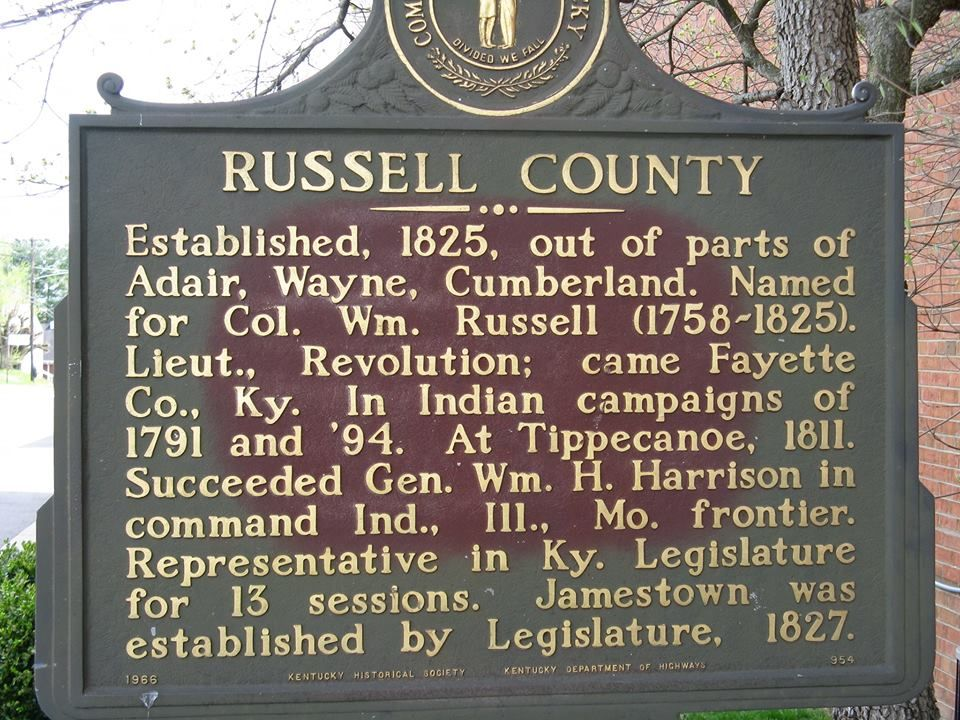
Colonel Russell’s legacy is etched into the geography and institutions of the American frontier. In 1825, Russell County, Kentucky was named in his honor, recognizing his decades of military service and civic leadership. Fort Russell Township in Illinois also bears his name. However, Russellville, Kentucky and Russell County, Virginia were named for his father, Brigadier General William Russell. Colonel Russell died on July 3, 1825, in Lexington, Kentucky, and was buried in The Lexington Cemetery. His life—spanning frontier hardship, revolutionary struggle, and state-building—embodies the pioneering spirit of early America.